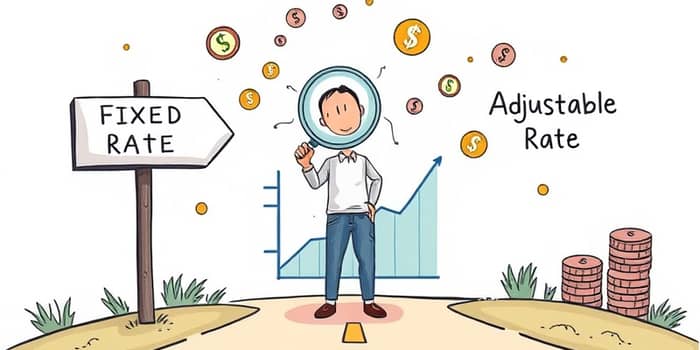
Interest rates are the heartbeat of our financial system, influencing everything from buying a home to saving for retirement.
Interest is the price of money, and grasping its mechanics can save you thousands over a lifetime.
This knowledge transforms borrowing from a burden into a strategic tool for achieving your dreams.
By the end of this article, you'll see interest not as a mysterious force, but as a controllable element in your financial plan.
What Is Interest? The Foundation of Finance
At its simplest, interest is money paid as the cost of borrowing or earned on deposits and investments.
Lenders charge interest to compensate for risk and the opportunity cost of parting with their funds.
For borrowers, it represents an additional expense; for savers, it's a reward for patience and prudence.
This dual role makes understanding interest rates essential for anyone navigating loans or investments.
How Interest Rates Are Determined: The Factors at Play
Rates aren't set arbitrarily; they're crafted from a blend of personal and economic ingredients.
Risk-based pricing is key, where lenders assess your creditworthiness, loan term, amount, and collateral.
Your credit score, history, and financial stability directly influence the rates you're offered.
Market benchmarks, like the prime rate, tie into broader indicators such as the Federal Reserve's funds rate.
This connection helps manage inflation and steer the economy, affecting everyone from homebuyers to businesses.
- Credit Score: Higher scores often secure lower rates, reducing long-term costs.
- Loan-to-Value Ratio (LTV): A lower LTV can lead to better terms by minimizing lender risk.
- Debt-to-Income Ratio (DTI): Maintaining a low DTI signals financial health and can lower rates.
- Loan Purpose: Rates may vary for purchases versus refinances, impacting your strategy.
- Collateral: Secured loans, backed by assets, typically come with more favorable rates.
These factors intertwine to create a personalized rate that reflects your financial profile.
Fixed vs. Adjustable Rates: Choosing Your Financial Path
Most borrowers encounter a choice between fixed and adjustable-rate mortgages (ARMs), each with distinct advantages.
Fixed-rate loans provide stability with consistent monthly payments throughout the term.
From 2008 to 2022, 85-95% of buyers opted for fixed rates, valuing predictability in their budgets.
In contrast, adjustable-rate mortgages start with lower introductory rates but can fluctuate later.
ARMs accounted for 5-15% of choices, appealing to those planning short-term ownership or expecting rate drops.
- Fixed Rates: Ideal for long-term planning, offering peace of mind against market volatility.
- Adjustable Rates: Suitable for flexible timelines, with rate caps to limit potential increases.
This decision hinges on your financial goals and risk tolerance, shaping your loan's total cost.
Simple vs. Compound Interest: The Math That Matters
How interest accrues can dramatically affect your financial outcomes, whether you're borrowing or saving.
Simple interest is calculated only on the principal amount, making it straightforward but less impactful.
For example, $100 at 5% for three years yields $15 in interest, with no growth on earnings.
Compound interest, however, earns interest on previously accrued interest, amplifying effects over time.
With semiannual compounding on the same $100, the effective rate rises to 5.06%, resulting in $5.06 total interest.
This compounding effect can work for you in savings or against you in debt, emphasizing the power of time.
The Impact of Loan Terms: Short vs. Long
Loan duration is a critical factor that influences both monthly payments and overall cost.
Shorter terms, like 15-year mortgages, come with higher monthly payments but lower interest rates and total cost.
Longer terms, such as 30-year loans, offer lower payments but accrue more interest, increasing the total expense.
This table highlights the trade-offs, empowering you to align loan terms with your financial capacity and goals.
Interest Rate vs. APR: Understanding the True Cost
The interest rate is just one piece of the puzzle; the Annual Percentage Rate (APR) reveals the full picture.
APR includes fees such as origination charges, providing a more accurate measure of borrowing cost.
Always compare APRs when shopping for loans to avoid hidden expenses and make informed decisions.
- Interest Rate: Reflects the cost on the principal alone, useful for basic comparisons.
- APR: Encompasses all costs, offering a true representation of what you'll pay over the loan's life.
This distinction can save you money by ensuring you're not lured by low rates that mask high fees.
Economic Influences on Rates: The Bigger Picture
Interest rates are deeply connected to the economy, shaped by policies and market conditions.
The Federal Reserve adjusts rates to control inflation and stimulate employment, affecting borrowing costs across the board.
Rate hikes curb spending by making loans more expensive, while cuts encourage growth and investment.
These changes ripple through various loan types, from short-term Treasury bills to long-term mortgages.
- Short-Term Loans: Highly sensitive to Fed policies, common for vehicles or credit cards.
- Long-Term Loans: Influenced by economic trends and investor expectations, impacting mortgages significantly.
Understanding these influences helps you anticipate rate movements and plan accordingly.
Loan Types and Borrower Factors: Tailoring to Your Needs
Different loans serve diverse purposes, with rates shaped by your unique financial situation.
Mortgages, personal loans, and vehicle loans each have specific considerations and eligibility criteria.
Government-backed loans like FHA, VA, and USDA offer special terms for eligible borrowers, such as lower down payments.
Your income, credit history, and down payment size all play roles in determining the rates you qualify for.
- Mortgages: Often the largest loan, with rates affected by factors like LTV and DTI.
- Personal Loans: Typically unsecured, with rates based on credit score and loan purpose.
- Vehicle Loans: Secured by the car, with terms varying by lender and borrower risk profile.
Choosing the right loan type can optimize your rates and align with your financial objectives.
Why Rates Matter: Real-World Examples and Calculations
Small differences in interest rates can lead to substantial cost variations, making vigilance crucial.
For a $15,000 vehicle loan over 48 months, a 5% rate means $1,581 in total interest.
At 7%, this jumps to $2,241, an increase of $660 that highlights the impact of higher rates.
On a $200,000 mortgage over 15 years, a 3% rate results in $248,609 total, while 5% costs $284,686, adding $36,077.
- Example: A personal loan of $10,000 at an average APR of 12.64% costs $2,067 interest over three years.
- At 35.99% APR, the interest soars to $6,487, underscoring the importance of shopping for low rates.
These examples demonstrate how rate choices directly affect your wallet and long-term financial health.
Savings Tips and Final Thoughts: Taking Control of Your Finances
Arm yourself with practical strategies to minimize interest costs and maximize your financial well-being.
Shop around for rates and use online calculators to compare multiple loan offers before committing.
Opt for shorter loan terms when possible to reduce total interest accrual and pay off debt faster.
Improve your credit score and maintain a low DTI to qualify for better rates and save thousands over time.
- Use loan estimators to model different scenarios and find the best fit for your budget.
- Consider refinancing if rates drop significantly, potentially lowering your monthly payments.
- Save diligently to build an emergency fund, reducing reliance on high-interest debt in crises.
By mastering these concepts, you can navigate loans with confidence, making choices that support your aspirations and secure a prosperous future.
Interest rates are more than just numbers; they're tools that, when understood, can empower you to build wealth and achieve financial freedom.
References
- https://www.experian.com/blogs/ask-experian/what-is-interest/
- https://www.consumerfinance.gov/owning-a-home/explore/understand-the-different-kinds-of-loans-available/
- https://investor.vanguard.com/investor-resources-education/article/how-do-interest-rates-work
- https://www.navyfederal.org/loans-cards/mortgage/mortgage-rates.html
- https://www.equifax.com/personal/education/personal-finance/articles/-/learn/what-do-interest-rates-mean/
- https://www.bankrate.com/loans/loans-comparison-calculator/
- https://www.guidestone.org/Resources/Education/Articles/Investments/Understanding-Interest-Rates
- https://www.wellsfargo.com/mortgage/rates/
- https://www.consumerfinance.gov/ask-cfpb/what-is-the-difference-between-a-loan-interest-rate-and-the-apr-en-733/
- https://finaid.org/calculators/loancomparison/
- https://www.discover.com/personal-loans/resources/consolidate-debt/apr-vs-interest-rate/
- https://www.mortgagecalculator.org/calcs/compare.php
- https://www.pennymac.com/rates
- https://www.usbank.com/home-loans/mortgage/mortgage-rates.html
- https://www.rate.com/mortgage/mortgage-rates