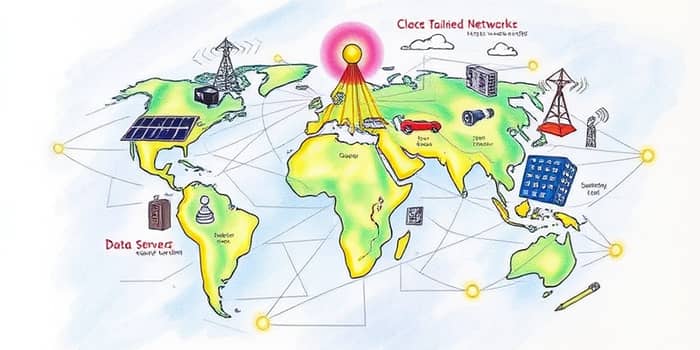
At the crossroads of technology and community lies a powerful movement reshaping how we build and share the foundations of modern life. DePIN stands for Decentralized Physical Infrastructure Networks, a paradigm shift that empowers individuals to co-own everything from energy grids to wireless coverage, harnessing the full potential of blockchain innovation.
Definition and Core Concept of DePIN
DePIN is more than a buzzword; it represents a fundamental reimagining of physical systems. By transforming hardware assets into tradable entities on a ledger, DePIN fosters an ecosystem where participants can contribute and earn in a seamless, transparent manner. At its heart, this model breaks away from traditional corporate and governmental control, offering a path to democratize essential services.
Through the integration of blockchain technology, participants benefit from an immutable record-keeping layer that logs every contribution and transaction. By leveraging smart contracts, payment settlements and governance become automated, reinforcing permissionless participation for all contributors without sacrificing accountability or trust.
Consider a remote village where local farmers install weather sensors and link them to a blockchain. In exchange for sharing accurate climate data, participants earn tokens that offset energy costs, fund community projects, and foster resilient agricultural practices.
Historical Origins and Evolution
The seeds of DePIN were sown in the early days of blockchain, when proof-of-work pioneers showcased how physical resources could secure digital currencies. Projects like Filecoin and iExec laid critical groundwork by turning storage and computing power into decentralized markets.
Early adopters in technology hubs also experimented with token rewards for lending compute power, foreshadowing the broader potential of DePIN. These pilot initiatives proved that decentralized communities could efficiently manage scarce resources without central oversight.
How DePIN Works: Key Mechanisms
At its core, a successful DePIN implementation relies on several interlocking components:
- Physical Infrastructure Providers: Individuals and organizations contribute routers, sensors, solar arrays, storage drives, and more.
- Middleware and Oracles: Specialized software bridges real-world devices with the blockchain, validating usage data and performance metrics.
- Blockchain Ledger: An immutable database that records transactions, governs token issuance, and enforces smart contract logic.
- Tokenization and Incentives: Resources are encapsulated as on-chain tokens, rewarding contributors and enabling peer-to-peer trading.
- Decentralized Governance: DAOs or similar structures ensure control aligns with contributions, mirroring distributed systems in nature.
Consider a solar energy network: homeowners install panels and upload performance readings via oracles. When surplus power is available, smart contracts execute trades directly with neighbors, settling payments automatically and securely.
Categories of DePIN Applications
These categories illustrate the versatility of DePIN, demonstrating how tokenization can unlock new efficiencies and foster sustainable growth across industries.
Transformative Benefits of DePIN
The shift to decentralized infrastructure brings a wealth of advantages that ripple through economies and communities. By dismantling centralized monopolies, DePIN champions resilience, transparency, and inclusivity.
- Cost Efficiency: Eliminates intermediaries and reduces operational overhead, allowing participants to retain more value.
- Scalability: Networks expand organically as new providers join, with no central approval required.
- Security & Reliability: Distributed nodes resist outages and attacks, ensuring continuous service delivery.
- Innovation Catalyst: Open-source protocols invite collaboration, spurring novel applications and integrations.
By integrating renewable energy sources and democratizing access to essential services, DePIN also drives environmental stewardship. Every kilowatt-hour generated or data packet transmitted becomes a testament to collective action and shared prosperity.
By redistributing economic power to individuals and communities, DePIN fosters equitable and sustainable growth models that challenge the status quo and inspire a more balanced future.
Overcoming Challenges and Risks
While DePIN promises incredible potential, it must navigate technical, regulatory, and social hurdles. Hardware integration demands robust standards to ensure uptime and interoperability with blockchain platforms.
Regulatory landscapes vary widely, particularly in telecommunications and energy. Teams must engage with policymakers and design compliant frameworks that protect consumers without stifling innovation.
- Technical Complexity: Ensuring reliable hardware-software integration across diverse environments.
- Regulatory Uncertainty: Adapting to evolving legal requirements in multiple jurisdictions.
- User Experience: Simplifying interactions so non-technical participants can join seamlessly.
Education and intuitive onboarding tools are key to lowering barriers. Workshops, community-driven tutorials, and user-friendly dashboards can help individuals of all backgrounds participate confidently in DePIN networks.
Pioneering Projects and the Growing Ecosystem
A vibrant community of developers and entrepreneurs is already leading the way. Filecoin has transformed data storage into a competitive market, while Render delivers GPU power to creators and researchers at scalable prices. Helium's wireless hotspots demonstrate how everyday devices can form expansive communication networks.
Each success story strengthens the message that collaborative, token-based models can outperform traditional incumbents. As more projects join this wave, the ecosystem evolves, sharing best practices and forging partnerships that amplify impact.
Technical Foundations for Scaling DePIN
For DePIN to thrive, underlying blockchains must support high throughput and low-latency transactions. Layer-two solutions and interoperable bridges will be essential to connect disparate networks and legacy systems.
Cross-chain compatibility remains a vibrant area of research, with emerging protocols enabling assets and tokens to move freely between blockchains. This interoperability lays the groundwork for an interconnected DePIN landscape.
This architectural shift embodies proof of physical work that rewards, aligning incentives with real-world impact and ensuring long-term viability.
A Vision for a Decentralized Future
Imagine a world where communities power their neighborhoods with solar panels, trade bandwidth with neighbors, and rent computing power to global researchers—all governed by transparent protocols and fair incentives. In this vision, infrastructure becomes a shared tapestry woven from individual contributions.
Such networks will redefine the relationship between people and the systems they rely on. When infrastructure is a shared asset, communities become the architects of their own destiny, forging resilient connections that transcend geopolitical boundaries.
DePIN heralds an era of empowerment, resilience, and equitable growth. By embracing this model, we can build systems that serve humanity and the planet, inspiring generations to come to innovate and collaborate on a truly global scale.
References
- https://www.coingecko.com/learn/depin-crypto-decentralized-physical-infrastructure-networks
- https://www.ulam.io/blog/how-depin-is-revolutionizing-infrastructure-in-the-web3-era
- https://cryptoforinnovation.org/decentralized-physical-infrastructure-network-depin-explained/
- https://www.iex.ec/academy/depin-crypto-physical-infrastructure
- https://en.wikipedia.org/wiki/Decentralized_physical_infrastructure_network
- https://uplink.xyz/blog/what-is-depin
- https://www.kraken.com/learn/what-is-depin
- https://www.jpmorgan.com/kinexys/content-hub/depin-decentralized-physical-infrastructure-networks
- https://thegraph.com/blog/the-future-of-depin/
- https://a16zcrypto.com/posts/listicles/why-depin-matters/
- https://www.finalis.com/blog/depin-the-new-tech-standard