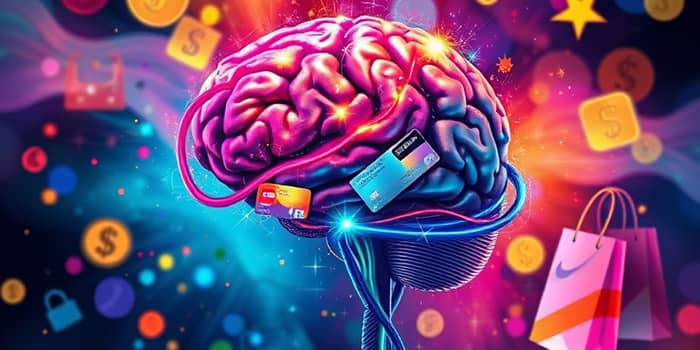
In an era where digital transactions dominate, credit cards have reshaped our spending habits in ways we often fail to recognize. activate the reward center of the brain, creating a powerful psychological pull that can lead to overspending and debt.
This article explores the hidden neural and emotional triggers behind our financial decisions, offering actionable insights to regain control.
By understanding these mechanisms, you can transform your relationship with money and build a more secure future.
The Brain's Reward System: How Credit Cards Hijack Our Neural Pathways
Credit cards tap into our brain's reward systems with remarkable efficiency. fMRI studies reveal that simply seeing a credit card logo can trigger spending impulses before conscious decision-making.
This occurs because credit card use stimulates the striatum, a key part of the dopaminergic reward center.
The same region is exploited by addictive substances, highlighting why credit cards can foster compulsive spending behaviors.
- Credit cards activate the reward center of the brain, similar to how drugs like cocaine do.
- MIT research shows credit card users bid more than twice as much as cash users in auctions.
- The psychological cost of a dollar on credit feels like only fifty cents, reducing spending restraint.
This neural cycle involves a card swipe, dopamine release, and delayed financial pain, reinforcing habits over time.
The Pain of Payment: Why Cash Makes Us Think Twice
Paying with cash creates a tangible discomfort known as the "pain of paying." This sensation acts as a natural brake on spending.
Cash transactions activate the insular cortex, which processes physical pain, making consumers more cautious.
In contrast, credit cards remove this pain, creating psychological distance between purchase and payment.
As a result, people spend more, choose higher-priced items, and make more impulse buys with credit.
- Cash payments increase emotional attachment to products, while credit reduces it.
- The ease of credit cards facilitates unplanned purchases, especially in online shopping contexts.
Psychological Mechanisms: Release the Brakes vs. Step on the Gas
Two hypotheses explain credit card spending: "release the brakes" and "step on the gas." The latter suggests credit cards actively motivate spending.
MIT fMRI studies confirm that credit cards step on the gas by sensitizing reward networks.
Payment coupling, or the delay between purchase and payment, makes it psychologically easier to spend future money.
Rewards and points add positive reinforcement, further driving spending behavior.
- Credit cards reduce the pain of payment, lowering psychological barriers.
- They increase motivation through reward activation and delayed financial impact.
- This mechanism is similar to casino tactics that exploit conditioning.
Emotional Triggers: How Moods Drive Unplanned Spending
Emotions like stress, celebration, boredom, and social pressure often lead to unplanned spending. Credit cards enable "retail therapy" as a coping mechanism.
Shopping can elevate moods, particularly for impulse buyers who seek immediate gratification.
The ease of credit transactions makes impulse buying more likely and frequent, especially during late-night online sessions.
- Stress and boredom are primary drivers of emotional spending.
- Credit cards facilitate impulse purchases by removing payment friction.
- Real-world examples show budgets being exceeded by significant margins.
Individual Differences: Tightwads and Spendthrifts
Not everyone responds to credit cards similarly. Personality traits like being a tightwad or spendthrift influence spending behavior.
Tightwads experience intense pain of paying and are more sensitive to contexts that reduce it.
Spendthrifts, with low payment pain sensitivity, may overspend regardless of payment method.
Understanding your tendencies can help tailor financial strategies for better control.
This table highlights key behavioral differences influenced by payment methods.
Long-Term Consequences: Debt, Attachment, and Financial Security
The convenience of credit cards often leads to increased household debt and reduced savings. As credit card adoption rises, so does consumer debt.
Impulse buying can spiral into overspending and debt accumulation, impacting financial stability.
- Overspending strains budgets and limits savings for future goals.
- Debt accumulation increases stress and reduces financial freedom.
- Lower savings affect long-term security, such as retirement planning.
Cash payers develop stronger post-transaction connections, fostering loyalty in repeated purchases.
Future Implications: Navigating a Cashless Society
As digital payments expand, understanding psychological influences is critical. Without care, simple acts like using a phone could trigger spending appetites.
Novel payment instruments must be designed with awareness to prevent exploitation of reward networks.
Convenience should not compromise financial well-being and control.
- Digital payments could amplify spending triggers without safeguards.
- Education on psychological mechanisms is essential for responsible use.
- Future technologies need to balance ease with financial mindfulness.
Actionable Insights: Strategies for Smarter Spending
To combat credit card influence, start by understanding your triggers. Monitor spending habits, especially during emotional highs and lows.
Use cash for discretionary purchases to reintroduce the pain of payment and increase mindfulness.
Set clear budgets and avoid saving payment details online to reduce impulse buys.
- Track spending to identify patterns and emotional triggers.
- Use cash for categories like dining or entertainment to enhance control.
- Limit credit card use to essentials or pay off balances immediately.
- Educate yourself on cognitive biases like the compromise effect.
- Seek professional advice if debt becomes unmanageable.
By leveraging this knowledge, you can take control of your finances and align spending with personal goals.
Remember, awareness empowers change. Embrace these insights to foster a healthier, more intentional relationship with money.
References
- https://mitsloan.mit.edu/experts/how-credit-cards-activate-reward-center-our-brains-and-drive-spending
- https://www.bankrate.com/credit-cards/advice/psychology-of-credit-card-spending/
- https://www.nerdwallet.com/credit-cards/learn/credit-cards-make-you-spend-more
- https://www.airtel.in/blog/credit-card/why-we-overspend-the-psychology-of-credit-card-spending/
- https://pmc.ncbi.nlm.nih.gov/articles/PMC12174854/
- https://www.paymentsjournal.com/consumers-spend-more-impulsively-with-cards-and-dont-mind/
- https://betterworld.mit.edu/spectrum/issues/winter-1999/the-psychology-of-spending/
- https://freshcredit.com/the-psychology-of-credit-understanding-consumer-behavior/
- https://academic.oup.com/jcr/article-abstract/13/3/348/1822480
- https://www.indusind.bank.in/iblogs/credit-card/the-psychology-of-credit-card-spending-how-to-avoid-impulse-purchases/
- https://www.cmu.edu/homepage/practical/2007/winter/spending-til-it-hurts.shtml