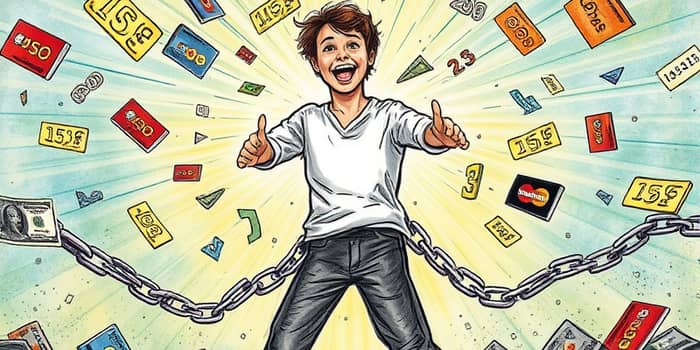
Credit card debt has become a silent epidemic in modern America, affecting millions across all walks of life. While the numbers can be staggering, understanding the underlying forces driving overspending and mounting balances is the first step toward freedom. This article explores the psychology behind credit card use, the debt cycle that ensnares so many, and the actionable strategies that empower you to reclaim control of your finances.
Understanding the credit card debt epidemic
The total U.S. credit card debt soared to $1.23 trillion in Q3 2025, marking a 5.75% increase year-over-year. With 61% of debtors carrying balances for at least a year and average balances at $7,886 per person, the weight of interest charges can feel overwhelming. Yet these raw figures only tell part of the story: behind every statistic lies a human struggle with impulse, emotion, and long-term planning.
Nearly half of all cardholders revolve their balances month to month, while 53% manage to pay in full. This division highlights a crucial truth: having a card is not the problem, but how and why it’s used shapes financial destiny. When purchases become driven by more than need—when they fulfill an emotional urge or grant instant reward—balances can spiral out of control.
Core psychological factors driving credit card debt
At the heart of credit card overspending lie deep-seated mental triggers. Neuroscience shows that plastic payments activate our brain’s reward centers more intensely than cash, making each swipe feel gratifying and frictionless. Similarly, emotions like stress or boredom can prompt unplanned purchases, creating a cycle of comfort spending that amplifies debt rather than alleviates it.
- Instant gratification overrides long-term goals: Cards blur the pain of paying, encouraging impulsive decisions.
- Denial and avoidance exacerbate balances: Ignoring statements delays the shock of mounting interest.
- Present bias fuels short-term focus: Immediate joy outweighs future financial well-being.
- Emotional spending as a coping mechanism: Purchases serve as temporary relief from stress.
- Shame and hopelessness perpetuate the cycle: Anxiety about debt can lead to further reckless spending.
How the debt cycle escalates
The debt cycle often begins innocently: a birthday gift here, a holiday treat there. But interest rates near 24% can balloon small balances into mountains, and minimum payments cover mostly interest, barely touching principal. As the balance climbs, stress increases, triggering more emotional purchases in a misguided attempt to feel better.
- Small debts accumulate unnoticed: Minor purchases add up faster than expected.
- Interest and minimum payments prolong debt: Higher rates mean less principal is paid each month.
- Stress triggers further overspending: Emotional relief through retail therapy deepens balances.
- External shocks intensify the burden: Emergencies or holiday bills can push accounts past breaking point.
- Habit persistence cements patterns: Credit utilization tends to return to its baseline.
Empowering strategies to break free
While the cycle can feel unbreakable, countless success stories show that change is possible. The key lies in both mindset shifts and concrete actions. By acknowledging the problem and taking control of triggers, anyone can chart a path toward debt freedom.
- Track and confront your spending: Review statements weekly to identify emotional purchases.
- Use cash or debit when possible: Limiting plastic reduces impulse buys.
- Pay more than the minimum: Focus on high-interest cards first to maximize impact.
- Build an emergency fund: Even $500 can prevent debt from unforeseen expenses.
- Seek support without shame: Financial counseling or peer groups normalize the struggle.
- Set realistic budgets and goals: Clear targets foster accountability and progress.
Who is most impacted?
Gen X and lower-income households carry the greatest burdens, while younger adults often lack experience or face limited credit options. Understanding these demographic trends helps tailor educational efforts and support services where they’re needed most.
The broader context and hopeful trends
Despite daunting figures, there are reasons for optimism. National delinquencies remain stable, and recent Federal Reserve rate cuts are nudging APRs downward for the first time in months. Many consumers resolve to tackle balances after holiday splurges, joining a post-January wave of budgeting enthusiasm.
Financial technology innovations—such as apps that round up expenses into savings or automatically allocate extra payments toward high-interest cards—offer practical allies in the fight. Educational initiatives are emphasizing mental health aspects, teaching that combating shame is as vital as mastering spreadsheets.
Ultimately, this challenge is as much psychological as it is financial. By recognizing the triggers that drive overspending, replacing harmful habits with intentional practices, and leveraging supportive tools, you can transform anxiety into action and uncertainty into confidence. The journey to debt freedom is not always linear, but each step forward builds momentum toward lasting liberation.
Embrace the process—one payment, one realization, one habit shift at a time—and you will find that the power to break free has been within you all along.
References
- https://www.moneyfit.org/psychology-of-credit-card-debt/
- https://www.marketplace.org/story/2026/01/13/more-americans-burdened-by-longterm-credit-card-debt-study-says
- https://www.bankrate.com/credit-cards/news/new-credit-card-debt-research/
- https://intellipay.com/habitsshift/
- https://newschannel9.com/news/local/credit-card-debt-reaches-123-trillion-how-consumers-are-recovering-financially
- https://pmc.ncbi.nlm.nih.gov/articles/PMC4707673/
- https://newsroom.transunion.com/2026-consumer-credit-forecast/
- https://www.debt.org/credit/cards/how-do-people-get-trapped-in-cycles-of-credit-card-debt/
- https://www.lendingtree.com/credit-cards/study/credit-card-debt-statistics/
- https://wealthandfinance.digital/the-psychology-of-debt-rewiring-the-brain-for-financial-success/
- https://www.newyorkfed.org/microeconomics/hhdc
- https://www.psychologytoday.com/us/blog/the-psychology-of-debt/202502/overcoming-the-shame-of-credit-card-debt
- https://www.federalreserve.gov/releases/g19/current/
- https://mitsloan.mit.edu/experts/how-credit-cards-activate-reward-center-our-brains-and-drive-spending