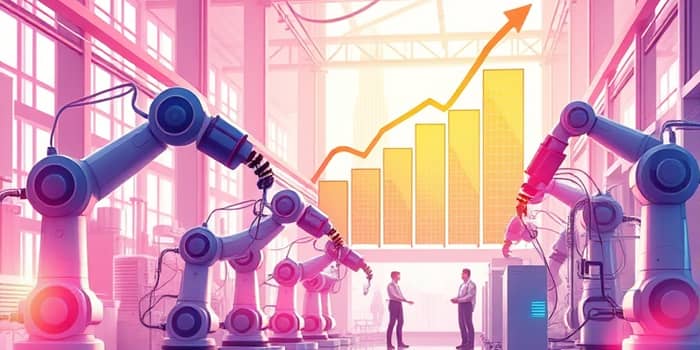
The global economy is experiencing a remarkable shift as technological advances unlock unprecedented efficiency. Yet beneath this surface of prosperity lies a paradox: productivity gains soar while job creation and wage growth lag. Known as the Productivity Puzzle, this tension between booming output and subdued labor market outcomes challenges policymakers, businesses, and workers alike.
Drawing on data from Q3 2025 through forecasts for 2026, we explore how AI, automation, and capital investment drive above-trend GDP growth without inflation, while raising serious questions about equity, sustainability, and long-term employment. This article provides insights, practical guidance, and strategic frameworks to navigate this complex landscape.
Understanding the Productivity Puzzle
In Q3 2025, nonfarm business productivity surged by 4.9%, propelled by real value-added output growth of 5.4% against a mere 0.5% uptick in hours worked. Thanks to automation, data tools, and AI adoption, unit labor costs fell 1.9%. Yet hiring slowed, with job creation averaging around 40,000 positions per month going into 2026.
This dynamic illustrates the core tension: how can an economy expand robustly without matching increases in employment? The answer lies in capital deepening, technological diffusion, and shifts in industry structure. As high-productivity firms scale, resources concentrate, leaving smaller or less tech-savvy businesses struggling to keep pace.
Key Drivers Behind Recent Gains
Several factors underpin the productivity acceleration seen in the U.S. and other advanced economies. Understanding these drivers can help stakeholders seize opportunities while mitigating risks.
- AI-driven productivity boom: Investment in machine learning, robotics, and cloud computing delivers outsized efficiency improvements.
- Capital deepening and automation: Plant and equipment upgrades reduce labor intensity across manufacturing and services.
- Business dynamism and reallocation: Resources shift toward high-tech firms, boosting overall average output per worker.
- Intangible assets investment: Software, R&D, and data infrastructure spending drive sustained gains.
Global Landscape and Comparisons
While the U.S. leads in productivity growth, other regions show mixed results. Below is a snapshot of 2026 GDP growth forecasts and underlying factors.
These projections highlight the U.S. exceptionalism: stronger R&D investment, flexible labor markets, and a robust tech ecosystem. In contrast, Europe faces rigid regulations and weaker R&D, while developing economies contend with debt burdens and infrastructure gaps.
Labor Market Tensions and Risks
Despite corporate earnings and GDP growth outpacing historical norms, the labor market tells a different story. Summer 2025 saw near-stagnant hiring levels, raising fears of a jobless recovery and inequality. Wages have grown at roughly one-quarter the pace of profits, creating a bifurcated workforce.
Key concerns include:
- Dampened consumer spending if wage gains remain muted.
- Rising unemployment in routine occupations exposed to automation.
- Geographic and demographic disparities, as older workers face steeper retraining costs.
Policymakers must navigate this delicate balance: promoting innovation without leaving large segments of the workforce behind. Public investment in education, targeted upskilling programs, and incentives for equitable AI deployment will be critical.
Investment Returns and Strategic Implications
For investors, the Productivity Puzzle presents both opportunities and pitfalls. Sustained productivity gains support earnings growth and expansive valuations in tech and capital-intensive sectors. Yet the distribution of benefits will determine consumer demand and broader market resilience.
Consider these strategic angles:
- Position in sectors with high AI adoption runway, such as healthcare diagnostics and logistics automation.
- Monitor unit labor cost trends as leading indicators of margin pressure or expansion.
- Diversify across geographies: balance U.S. tech exposure with emerging markets benefiting from nearshoring waves.
Looking Ahead: Opportunities and Challenges
As we move beyond 2026, the sustainability of productivity-driven growth hinges on broad diffusion of technology and inclusive labor market policies. Key trends to watch include:
- The evolution of the AI J-curve, where short-term implementation slowdowns give way to rapid efficiency gains.
- Nearshoring dynamics, as firms re-evaluate supply chains under USMCA and geopolitical pressures.
- Fiscal and monetary policy balancing acts to support investment without triggering inflationary spirals.
Ultimately, the Productivity Puzzle is not merely an academic concern but a defining narrative of our economic era. By embracing targeted policies, fostering skills development, and aligning capital allocation with inclusive growth goals, stakeholders can transform this puzzle into a blueprint for shared prosperity.
References
- https://achinvest.com/the-productivity-advantage-powering-economic-growth-in-2026-weekly-market-commentary-january-26-2026/
- https://www.goldmansachs.com/insights/articles/the-global-economy-forecast-to-post-sturdy-growth-in-2026
- https://www.morganstanley.com/insights/articles/global-economic-outlook-2026
- https://www.deloitte.com/us/en/insights/topics/economy/global-economic-outlook-2026.html
- https://www.northerntrust.com/united-states/insights-research/2026/investment-perspective/navigating-risk-us-productivity-boom
- https://unctad.org/publication/world-economic-situation-and-prospects-2026
- https://hbr.org/2026/02/9-trends-shaping-work-in-2026-and-beyond
- https://ideas.darden.virginia.edu/productivity-boom