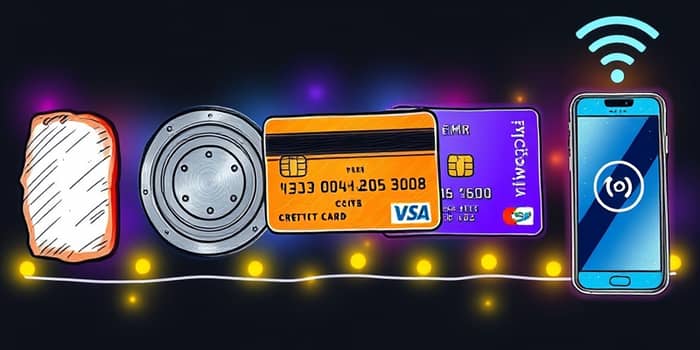
From the earliest clay tablets used for trade to today’s contactless smartphones, the journey of credit cards has been nothing short of extraordinary. This narrative explores how each innovation shaped the way we pay.
Throughout this exploration, we uncover how technological breakthroughs, regulatory milestones, and consumer demands have driven the shift toward frictionless consumer experiences across global commerce.
From Clay Tablets to Charge Cards
Long before plastic, traders recorded debts on clay tablets in ancient Mesopotamia. Fast forward to the 1920s, and New York hotel patrons carried the first metal charge plates to settle restaurant and lodging bills.
These metal “shopper’s plates” measured just 2.5 by 1.25 inches, but they laid the groundwork for an entire industry. By embedding customer names and addresses, merchants could track purchases and extend credit with newfound precision.
- Ancient clay tablets facilitating barter and credit
- 1920s hotel charge plates launching merchant credit
- 1949 Diners Club card debut after a forgotten wallet incident
- 1958 BankAmericard introduces a 25-day grace period
Magnetic Stripes and the Authorization Revolution
The 1960s ushered in revolutionary magnetic stripe technology, invented by IBM engineer Forrest Parry. By embedding iron oxide tape onto a card’s plastic surface, issuers could store account data and automate transaction processing.
This breakthrough enabled instant electronic authorization and transformed credit from a manual ledger system into a rapid, networked service. The formation of the Interbank Card Association—later Mastercard—solidified the global reach of these new cards.
The EMV and Contactless Era
Decades later, rising fraud concerns prompted the introduction of EMV chip cards. By 2004, RFID and contactless functionality arrived, first in select markets and then broadly after 2008.
EMV chips generate dynamic authentication codes for each purchase, making it exponentially harder to clone cards. Combined with contactless radio-frequency signals, they enabled the seamless tap-to-pay experience that consumers now expect.
Digital Wallets and Biometric Security
As smartphones proliferated, digital wallets emerged. Apple Pay, Google Wallet, and Samsung Pay leverage tokenization and biometrics—fingerprint or facial recognition—to authenticate transactions without exposing real card numbers.
Behind the scenes, enhanced encryption and tokenization processes transform sensitive details into one-time codes, while artificial intelligence and machine learning systems monitor patterns to flag suspicious activity in real time.
- Tokenization replacing card numbers with secure codes
- Biometric locks such as Face ID and Touch ID
- AI-driven fraud detection and personalized offers
- Virtual cards for online and in-app purchases
Challenges and Consumer Trust
Despite technological advances, the credit card industry has faced recurring challenges. In the 1960s, unsolicited mass mailings sparked widespread fraud, prompting regulators to ban auto-shipped cards and enforce applications-only policies.
Later, consumer protection laws such as the Truth in Lending Act improved transparency and dispute rights, building unprecedented consumer convenience and security into the system.
Looking Ahead: The Future of Payments
The next frontier extends beyond cards. Blockchain networks offer decentralized ledgers that promise tamper-proof transactions. Internet of Things devices—from smart refrigerators to connected cars—are being integrated with payment modules for in-the-moment purchases.
Emerging concepts like “Tap on Phone,” which turns any NFC-enabled device into a point-of-sale terminal, and magnetic secure transmission (MST) for older magnetic stripe systems, point to a world where every object could become a transactional interface.
Practical Tips for Adapting
To thrive in this swiftly evolving ecosystem, consumers can take proactive steps:
- Enable contactless and mobile payments for speed and hygiene
- Use biometric authentication wherever available
- Monitor statements regularly and set fraud alerts
- Consider virtual or single-use card numbers for online shopping
Conclusion
The story of credit cards is one of continuous reinvention, driven by a quest for speed, security, and convenience. From clay tablets to blockchain, each milestone reflects our collective desire for global payment networks that empower everyone.
By embracing new tools wisely—enabling fraud protections, choosing secure digital wallets, and staying informed—users can leverage the full benefits of tomorrow’s payment landscape today.
References
- https://thepointsguy.com/credit-cards/history-of-credit-cards/
- https://www.tryedge.io/blog/future-of-contactless-payments-unlocking-the-cutting-edge-technologies-and-innovations-transforming-transactions
- https://juztcard.com/resources/when-did-credit-cards-become-popular-history-and-evolution
- https://www.vanquis.com/take-control/when-were-credit-cards-invented/
- https://www.fsb1879.com/blog/the-evolution-of-contactless-payments-and-their-benefits
- https://www.swipesum.com/insights/history-of-the-credit-card
- https://www.marqeta.com/blog/tapping-into-the-future-a-guide-to-contactless-payments
- https://www.au.bank.in/blogs/history-and-invention-of-credit-cards
- https://www.mastercard.com/us/en/news-and-trends/stories/2024/10-top-payments-trends-for-2025-and-beyond.html
- https://www.atmmarketplace.com/blogs/the-history-of-credit-cards-the-evolution-of-payments/
- https://www.premierbankofthesouth.com/the-future-of-contactless-credit-cards
- https://www.bankofamerica.com/onlinebanking/education/the-way-we-pay-and-the-history-of-money.go?js=y