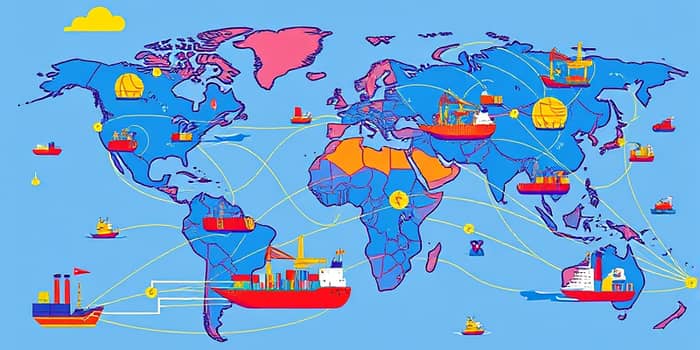
In an era of rapid geopolitical shifts and technological breakthroughs, the forces of international commerce profoundly influence domestic markets. Businesses, policymakers, and investors must navigate a complex web of costs, risks, and opportunities.
By examining historical patterns alongside modern dynamics, we gain insight into how trade winds shape national investment landscapes and what strategies can unlock growth.
Historical Waves of Globalization
Globalization has advanced in three distinct phases, each transforming economic relationships and investment flows.
During the first wave of globalization, which peaked before 1913, falling transport costs and industrial expansion connected Europe and the Americas. The United Kingdom dominated trade until World War I disrupted markets, triggering protectionism and a decline in cross-border flows.
The export-led growth and multinational supply chains characterizing the second wave (1950–2007) propelled global trade volumes from roughly $450 billion to $14.6 trillion. Governments embraced tariff reductions and multinational corporations stitched together intricate production networks spanning Asia, Europe, and the Americas.
As we enter the third wave (today–2050), forecasts anticipate world trade quadrupling to $68.5 trillion. Innovations like 3D printing, reverse innovation, and digital platforms drive digital technologies reducing trade barriers, enabling mass customization and empowering micro-multinationals to access global markets.
Trade Policies Shaping Investments
Government decisions on tariffs, quotas, and agreements directly affect corporate strategies and capital allocation.
- Tariffs and Quotas: Recent years have seen escalating tariffs and trade tensions, particularly between the United States and China. Taxes on steel, electronics, and agriculture have raised input costs and disrupted supply chains.
- Free Trade Agreements: The proliferation of FTAs reduces transaction costs, enhances market access, and fosters competition—driving down prices and expanding consumer choice.
- Non-Tariff Barriers: From data localization requirements to slow-walked licensing, regulatory measures can be wielded as instruments of economic leverage, adding layers of complexity for international investors.
These instruments not only shape cross-border flows but also recalibrate domestic investment patterns, prompting firms to rethink production locations and resource sourcing.
Geopolitical Dynamics and Economic Outlook
Rivalries among the United States, China, and other major powers cast a long shadow over trade corridors.
Since 2017, shifts in trade partnerships have emerged as countries diversify away from geopolitically distant blocs. Analysts project baseline trade growth to $45 trillion by 2035, yet under fragmentation scenarios—with 20% tariffs between distant partners—up to $14 trillion of trade remains vulnerable to volatility.
Geopolitical instability also spikes commodity price swings and heightens uncertainty, prompting investors to adopt more conservative forecasts and maintain larger risk buffers.
Direct Impacts on Domestic Investments
Changes in trade regimes translate into immediate effects on corporate decision-making.
When tariffs rise, input costs climb, squeezing profit margins and potentially passing higher prices to end consumers. Firms engage in supply chain restructuring and risk management, relocating manufacturing sites or seeking alternative suppliers to mitigate exposure.
- Cost Pressures: Anti-dumping and countervailing duties inflate expenses for downstream industries reliant on imported components.
- Uncertainty: Fluctuating policies deter long-term capital commitments, slowing expansion and innovation investments.
- Selective Protectionism: While tariffs may shield certain domestic sectors, downstream firms often bear the brunt of rising input costs.
Conversely, open trade regimes have historically lifted more than one billion people out of poverty by lowering prices, expanding market access, and fostering competition.
Key Statistics and Projections
Strategies for Business Resilience
In a rapidly shifting trade environment, agility becomes a competitive advantage.
Firms that leverage cheap logistics and strategic partnerships can swiftly adapt sourcing, while digital platforms enable direct customer engagement and customization. Diversifying supplier bases across multiple regions reduces exposure to country-specific disruptions.
Policy advocacy for policy openness and free trade agreements remains critical, as open markets foster innovation and drive down costs, fueling investment in research and development.
By embracing scenario planning and stress-testing assumptions, businesses can build robust frameworks to withstand tariff shocks, regulatory shifts, and geopolitical volatility.
Conclusion: Navigating Tomorrow’s Trade Winds
The interplay between global trade and domestic investment is as dynamic as it is complex. Historical lessons remind us that openness generally spurs prosperity, while protectionism often yields unintended costs.
As we chart a course through the third wave of globalization, stakeholders must balance risk mitigation with strategic opportunity-seeking. By understanding policy trends, geopolitical currents, and emerging technologies, businesses and governments can harness the transformative power of trade to drive sustainable growth and shared prosperity.
References
- https://www.crowell.com/en/insights/publications/trade-winds-how-global-businesses-are-navigating-trade-tariffs-and-the-uncharted-waters-ahead
- https://www.mckinsey.com/capabilities/geopolitics/our-insights/a-new-trade-paradigm-how-shifts-in-trade-corridors-could-affect-business
- https://www.smu.edu/cox/coxtoday-magazine/2018-10-01-global-trade-winds-in-north-america
- https://lifestyle.sustainability-directory.com/area/trade-winds/
- https://www.oecd.org/en/topics/policy-issues/global-trade-and-open-markets.html
- https://www.worldbank.org/en/topic/trade/brief/trade-has-been-a-powerful-driver-of-economic-development-and-poverty-reduction