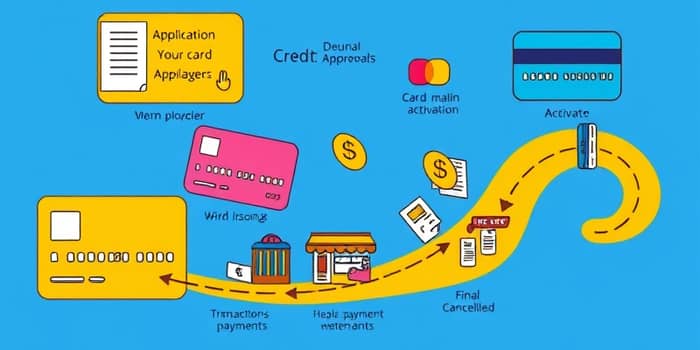
The journey of a credit card spans multiple critical stages, each demanding precise coordination between the cardholder, issuing bank, merchants, and payment networks. Understanding this lifecycle empowers consumers and businesses alike to optimize processes, control risk, and enhance overall satisfaction.
From the moment an individual applies for a card to the eventual closure or cancellation, every phase contributes to trust, convenience, and financial health. In this comprehensive guide, we explore each stage and share practical insights for navigating the credit card lifecycle with confidence.
Application Stage: Getting Started
Submitting a credit card application can take mere minutes or require more time depending on the chosen channel. Issuers pull credit reports, analyze income, payment history, and debt load through automated underwriting or manual review.
- Online portal submissions
- Phone-based applications
- In-branch paperwork
- Mail-in forms with supporting documents
Instant decisioning for strong profiles often returns an application result in under 60 seconds. When additional verification is needed, such as proof of income or address, the issuer may place the application in pending review, extending the process up to 30 days as mandated by federal regulations.
Issuance and Activation: Bringing the Card to Life
Once approved, card issuance involves secure distribution and personalization. Physical cards are printed with embossed details and mailed via secure courier, arriving typically within 7–10 business days post-approval.
To accelerate access, many issuers offer instant virtual card activation online through mobile apps, enabling cardholders to begin transacting digitally even before the physical card arrives.
Activation methods include phone call systems, mobile app prompts, and online portals. This step verifies the cardholder’s identity and arms the issuer with an active account ready for transactions.
During onboarding, banks often present welcome offers, educate users on key terms, and outline fraud prevention measures, laying the groundwork for a long-term relationship.
Transaction Processing Explained
Every purchase initiated with a credit card triggers a rapid, multi-party choreography that spans seconds to days. The process ensures secure authorization, batch processing, clearing, and final settlement.
- Customer requests authorization at the merchant point-of-sale
- Merchant acquirer forwards the request to the card network
- Network routes to the issuing bank to approve or decline
- Issuer places a hold and returns the response through the network
- Merchant completes the sale and groups transactions for batching
- Clearing exchanges transaction details between banks
- Settlement transfers funds from issuer to acquirer
The core of this flow—authorization, batching, clearing, settlement—dictates the speed of transaction completion and impacts merchant cash flow. Batching typically occurs daily, while settlement timelines vary by acquirer and merchant agreements.
Key participants include the cardholder, merchant, acquiring bank, payment processor, card network (Visa, Mastercard, Amex, Discover), and issuing bank. Each entity earns fees and assumes responsibilities for fraud detection, data security, and compliance.
Ongoing Management and Retention Strategies
Beyond initial issuance and usage, credit cards demand active management. Issuers monitor spending patterns, flag suspicious activities with fraud detection and monitoring systems, and tailor offers to keep cardholders engaged.
- Tiered rewards programs to boost engagement
- Personalized credit limit adjustments
- Targeted lifecycle marketing campaigns
- Proactive customer service outreach
Monthly billing cycles generate statements detailing purchases, fees, and minimum payments. Clear communication of due dates, interest rates, and penalty fees fosters trust and reduces drop-offs.
Issuers leverage analytics to segment customers by behavior, sending promotions that encourage higher utilization and on-time payments. Retention strategies like rewards and premium perks can significantly lower churn rates and extend the active life of a credit account.
Cancellation and End-of-Life: Closing the Loop
No credit card remains active forever. Whether due to voluntary closure, issuer-initiated termination, or natural expiration, the cancellation stage finalizes the lifecycle.
Cardholders must contact the issuer to confirm final balances, settle any outstanding amounts, and request closure. Issuers may levy closing fees or prorated annual charges, so understanding terms upfront is vital.
Upon cancellation, the issuer reports the account status to credit bureaus. A well-managed closure with zero balances can mitigate negative impacts on credit scores, while delinquent closures may harm credit standing.
Analyzing cancellation patterns offers issuers insights into product improvements. Feedback loops from departing customers highlight areas for streamlined processes, enhanced rewards, and better customer support.
Key Takeaways and Best Practices
From application to cancellation, a credit card’s journey involves intricate stages that balance user experience with risk management. By mastering each phase, consumers can secure favorable terms and maximize benefits, while issuers can optimize operations and foster loyalty.
Consider these actionable tips:
- Review eligibility criteria to speed up approval.
- Activate cards promptly using mobile or virtual methods.
- Monitor statements and set up alerts for unusual activity.
- Engage with rewards and retention offers to enhance value.
- Plan for closure by paying balances in full and confirming account status with the issuer.
Embrace the full lifecycle with awareness and intention. By doing so, you harness the power of credit responsibly, unlocking financial opportunities while safeguarding your credit health.
References
- https://www.globalpaymentsintegrated.com/en-us/blog/2018/08/01/the-lifecycle-of-a-credit-card-payment
- https://www.nerdwallet.com/credit-cards/learn/how-soon-can-i-get-my-new-credit-card
- https://www.worldpay.com/en/insights/articles/the-credit-card-lifecycle-explained
- https://www.remitly.com/blog/finance/how-long-does-it-take-to-get-a-credit-card/
- https://www.ixopay.com/blog/credit-card-life-cycle-what-is-it-and-how-can-you-manage-it
- https://www.bankrate.com/credit-cards/advice/how-long-does-it-take-to-get-credit-card/
- https://episodesix.com/payments-101-blog/the-credit-card-life-cycle-understanding-your-banks-customers
- https://www.creditonebank.com/articles/how-long-does-it-take-to-get-a-credit-card
- https://www.americanexpress.com/en-us/credit-cards/credit-intel/how-long-does-it-take-to-get-a-credit-card/
- https://stripe.com/resources/more/what-is-card-lifecyle-management-what-businesses-should-know
- https://www.chase.com/personal/credit-cards/education/basics/how-long-does-it-take-to-get-a-credit-card
- https://primer.io/blog/understanding-the-lifecycle-of-a-card-payment
- https://www.capitalone.com/learn-grow/money-management/how-long-does-it-take-to-get-a-credit-card/
- https://www.mastercard.com/us/en/news-and-trends/Insights/2024/the-guide-to-lifecycle-marketing-for-financial-institutions.html