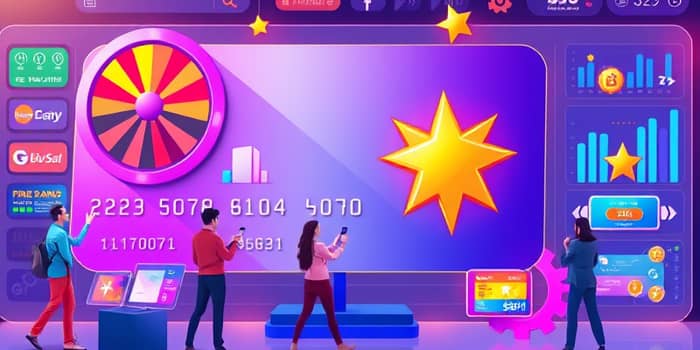
In today’s fast-paced financial landscape, credit card companies are no longer content with simple points and cashback. They’re embracing game design elements to reshape consumer behavior, drive engagement, and foster loyalty. By applying points, badges, simulations, and challenges to everyday spending, issuers transform routine transactions into strategic, rewarding experiences that benefit both users and providers.
Definition and Benefits of Credit Card Gamification
At its core, gamification is the application of game mechanics—such as levels, leaderboards, and rewards—to non-game scenarios. In credit cards, these mechanics encourage users to engage more deeply with their accounts, pay bills on time, and explore new features. The primary benefits include:
- Increased user engagement through interactive simulations and mini-games.
- Heightened customer loyalty via tiered rewards and achievement milestones.
- Accelerated spending growth driven by reward boosts and surprise prizes.
- Enhanced financial literacy through credit score simulators and educational quizzes.
These benefits translate into tangible outcomes: higher app ratings, reduced churn, improved brand perception, and optimized marketing spend.
Historical Context and Evolution
The journey began with simple loyalty cards offering points per purchase, redeemable for merchandise or discounts. As mobile apps rose to prominence, fintech innovators infused their platforms with game-like interfaces, leaderboards, and real-time progress tracking. This evolution shifted loyalty programs from passive reward systems to immersive financial adventures.
Today’s gamified credit experiences include interactive credit-score simulators, real-time reward wheels, and social competitions—far beyond the static points tables of the past.
Real-World Case Studies
Several pioneers illustrate gamification’s power:
- Capital One CreditWise: Offers a credit score simulator where users test scenarios—like paying balances or opening loans—and observe realistic scoring outcomes.
- CRED App: Combines rewards for bill payment with a UI reminiscent of classic video games, complete with playful reminders like celebratory cakes.
- Revolut: Delivers cashback, badges for savings goals, and bill-splitting games that foster social engagement.
These implementations have yielded remarkable results: millions of engaged users, multi-billion‐dollar valuations, and significant boosts in routine transaction volume.
Mechanics and Features That Drive Engagement
Key gamification elements include:
- Points and Badges: Reward each transaction or milestone, making progress visible and gratifying.
- Simulations: Offer credit-score projections and “what-if” scenarios to educate and guide decisions.
- Tiers and Levels: Unlock higher reward rates or exclusive perks as users advance.
- Mini-Games and Spins: Provide instant gratification through surprise cashback or prize wheels.
By blending these features, issuers create compelling, habit-forming experiences that outshine traditional reward programs.
Metrics and Impact
Quantifiable outcomes underscore gamification’s effectiveness:
For example, N26 boosted conversions by sevenfold through missions and interactive quizzes, while Ikano Bank’s “Flappy Saver” mini-game drew 1.5 million plays in a three-week campaign.
Challenges and Future Trends
Despite the benefits, challenges remain. Over-reliance on rewards can erode profit margins, and poorly designed mechanics may feel gimmicky. Privacy concerns also arise when apps analyze transactional data to personalize experiences.
Looking ahead, we anticipate emerging trends like:
- Adaptive weekly boosts that tailor rewards based on spending patterns.
- AI-driven personalization delivering real-time tailored offers and dynamic challenges.
- Cross-platform leaderboards integrating banking, investing, and digital wallets.
Strategies for Issuers Implementing Gamification
Issuers seeking to adopt gamification should consider:
- Personalize rewards using AI to match individual spending habits.
- Target demographics with nostalgia-inspired designs (e.g., pixel art reminiscent of classic arcade games) to engage millennials.
- Incentivize referrals by turning them into social competitions with visible leaderboards.
- Balance instant gratification (spins, mini-games) with long-term goals (tiers, badges) to maintain engagement.
By combining these tactics, issuers can craft resilient, user-centric programs that adapt and scale.
Conclusion
Credit card gamification is more than a marketing gimmick—it’s a strategic evolution in customer engagement and financial education. By integrating game mechanics into everyday transactions, issuers create meaningful, sustainable behavior change and foster deeper relationships with cardholders. As technologies like AI and data analytics advance, the most successful programs will be those that balance fun, personalization, and responsible financial guidance, empowering users to turn every swipe into a strategic win.
References
- https://www.capitalone.com/tech/software-engineering/applying-gamification-ui-ux/
- https://www.customerglu.com/blogs/gamification-in-cred
- https://aevi.com/newsroom/driving-customer-engagement-loyalty-through-gamification
- https://latinia.com/en/resources/gamification-in-banking
- https://mambo.io/blog/gamification-in-banking
- https://www.finextra.com/blogposting/25083/10-best-practice-examples-of-gamification-in-financial-services
- https://www.openloyalty.io/insider/fintech-gamification
- https://strivecloud.io/blog/fintech-gamification-examples
- https://strivecloud.io/blog/app-engagement-examples/
- https://www.theflyy.com/blog/gamification-of-digital-card-issuance
- https://corporateinsight.com/the-future-of-gamification-in-consumer-banking/
- https://yukaichou.com/gamification-examples/top-10-marketing-gamification-cases-remember/
- https://www.stampme.com/blog/gamification-loyalty-program-examples
- https://octalysisgroup.com/case-studies/
- https://www.finextra.com/blogposting/24419/gamification-when-does-it-make-sense-for-card-issuers