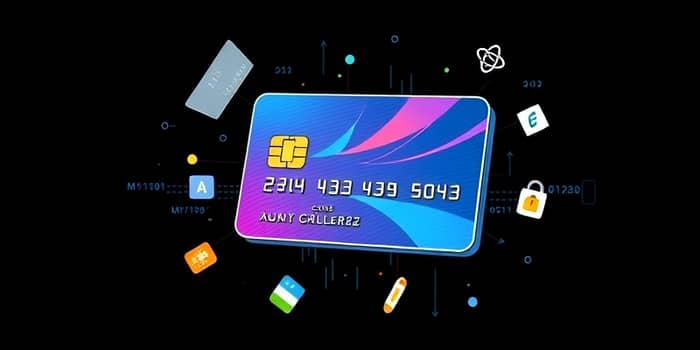
Credit cards have evolved from simple magnetic stripes to advanced chips and contactless technology. By dissecting each element, you gain a deeper appreciation for the intricate security layers protecting every transaction.
Front of the Card Components
The front face of a credit card showcases its most visible features. From issuer branding to chip technology, every item plays a role in functionality and trust.
- Card Issuer Logo: Positioned in the upper left, this logo indicates the bank or financial institution providing the credit line, managing rewards, statements, and customer service.
- Network Brand Mark: Often near the issuer logo, visible icons for Visa, Mastercard, American Express, or Discover dictate global acceptance and routing protocols.
- EMV Chip: The metallic square at center is a microprocessor generating unique one-time dynamic code per transaction, vastly improving security over magnetic stripes.
- Contactless Indicator: A curved series of lines signaling NFC capability, allowing tap-to-pay interactions that are both fast and encrypted.
- Cardholder Name: Printed below the chip or number, this ensures the card is tied to an authorized individual and aids in verification during in-person purchases.
- Expiration Date: Found beneath or beside the card number, it confirms the card’s validity and adds another verification layer for online or card-not-present purchases.
- Embedded Hologram: A 3D security image, sometimes on the front, preventing easy photocopying or counterfeiting.
Back of the Card Components
The reverse side hosts elements critical for transaction fulfillment and security. These features often interact with point-of-sale readers or online merchants.
- Magnetic Stripe: A black or brown band containing static data such as PAN, name, and expiration. Though being phased out, it still underpins legacy transaction methods worldwide.
- Primary Account Number (PAN): A 15–19 digit identifier—usually 16 digits for Visa/Mastercard, 15 for Amex—structuring BIN, account identifier, and Luhn check digit.
- CVV2 Security Code: A three- or four-digit code printed near the signature panel, verifying cardholder possession during online or phone transactions.
- Signature Panel: A white strip for the cardholder’s signature, enabling merchant verification in certain regions and providing an additional fraud deterrent.
- Secondary Hologram: Often mirrored on the back, reinforcing anti-counterfeit measures.
PAN Structure and Breakdown
The Primary Account Number is the backbone of card routing and fraud prevention. Its structure follows a precise layout:
• Major Industry Identifier (MII): First digit (e.g., 4 for Visa, 5 for Mastercard, 3 for Amex).
• Issuer Identification Number (IIN/BIN): Next 5–7 digits identifying the issuing bank and card type.
• Account Identifier: 6–9 digits unique to the cardholder account.
• Check Digit: Final digit validated via the Luhn algorithm.
This layered numbering system ensures accurate transaction routing globally and guards against simple typing errors.
Security Features and PCI DSS Roles
Security is paramount in card design. Companies adhere to PCI DSS guidelines to protect sensitive information both in transit and at rest.
Additional protective techniques include:
- Tokenization: Replaces the PAN with a unique token for digital transactions, reducing exposure.
- Dynamic Codes: EMV generates single-use codes per transaction, thwarting cloning attempts.
- NFC Encryption: Contactless transactions are encrypted end-to-end, adding a robust security layer.
Key Differences: Credit vs. Debit
While credit and debit cards share physical and digital components, their operational models diverge:
Credit cards provide a revolving line of credit, billing the cardholder later and often offering rewards or interest-free periods. Debit cards draw funds directly from the user’s bank account at the time of purchase. Despite identical EMV chips and CVV codes, these use cases affect dispute rights, overdraft protections, and fees.
Modern Evolutions and Fraud Prevention
Since the global EMV rollout began in the early 2010s, fraud from skimming has declined sharply. Contactless adoption is accelerating, especially post-2020, as consumers value speed and hygiene.
Reports indicate EMV chips have reduced counterfeit fraud by over 80% in regions where they are fully adopted. Yet, card-not-present schemes—online or phone orders—remain a challenge, fueling the growth of tokenization and biometric authentication.
As technology evolves, so do threat actors. Staying informed about features such as dynamic CVVs displayed on-screen or biometric cards can transform security. Always report lost or stolen cards immediately to minimize risk.
Conclusion
Understanding each component of a credit card—from its holograms and magnetic stripes to chips and tokenization—empowers you to use plastic money safely and confidently. Whether you’re a consumer or a merchant, recognizing these details helps you navigate daily transactions and emerging payment methods with greater awareness and protection.
References
- https://www.youtube.com/watch?v=qI66AufeYqE
- https://www.moneymax.ph/credit-card/articles/credit-card-parts
- https://www.shmoop.com/finance/credit-and-debit/credit-card-parts.html
- https://www.citizensbank.com/learning/credit-card-innovation-design.aspx
- https://blog.basistheory.com/credit-card-anatomy
- https://groundlabs.com/blog/anatomy-of-a-credit-card
- https://en.wikipedia.org/wiki/Payment_card_number