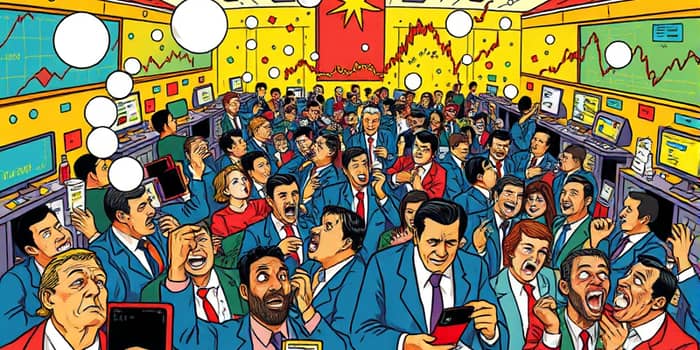
Financial markets are often celebrated as bastions of rationality, where prices swiftly adjust to new information.
Yet, beneath this surface, human emotions and biases constantly shape decisions, leading to predictable follies.
This article delves into the captivating world of behavioral economics, uncovering why markets misbehave and how you can harness this knowledge.
By understanding the psychological underpinnings, you can transform confusion into clarity and risk into opportunity.
We will explore key concepts, real-world examples, and actionable strategies to empower your financial journey.
The Myth of Rational Markets
Traditional finance relies on the Efficient Market Hypothesis (EMH), which assumes investors act rationally at all times.
However, behavioral economics challenges this view by highlighting our inherent irrationalities.
Markets are not cold, calculating machines but vibrant ecosystems influenced by psychology.
This shift in perspective explains why bubbles form and crashes occur, defying pure logic.
Embracing this reality is the first step toward smarter investing and avoiding common pitfalls.
Unpacking Psychological Biases
Investors often fall prey to mental shortcuts that distort their judgment.
Recognizing these biases can help you mitigate their impact on your decisions.
- Herd Behavior: Following the crowd without independent analysis.
- Overconfidence Bias: Excessively trusting your own abilities.
- Confirmation Bias: Seeking information that aligns with pre-existing beliefs.
- Anchoring Bias: Relying too heavily on initial information.
- Disposition Effect: Selling winners too early and holding losers too long.
These patterns create self-fulfilling prophecies that drive market volatility.
By identifying these tendencies, you can cultivate a more disciplined approach.
How Biases Shape Market Anomalies
Psychological factors give rise to persistent market anomalies that EMH cannot explain.
These include effects like momentum, where past performers continue to excel due to optimism.
Another is the value effect, where markets overreact to bad news, creating buying opportunities.
Reflexivity theory shows how prices and fundamentals interact in reinforcing cycles.
Limits to arbitrage mean rational traders cannot always correct these distortions.
This table summarizes key anomalies and their behavioral explanations:
Understanding these can guide you toward more strategic investments.
Lessons from Market History
Real-world events vividly illustrate how psychology drives market follies.
These examples serve as cautionary tales and learning opportunities.
- Dot-Com Bubble: A technology frenzy led to over-investment in unprofitable firms.
- 2008 Financial Crisis: Overconfidence in housing markets fueled excessive risk-taking.
- Bitcoin Bubble: Herding behavior caused rapid price surges and crashes.
- GameStop Short Squeeze: Collective action driven by sentiment over fundamentals.
Each case shows how irrational exuberance can override logic.
By studying history, you can spot early warning signs and adapt your strategies.
Characteristics of Bubbles
Bubbles follow recognizable patterns that signal impending trouble.
Key signs include unbridled optimism replacing fear and a belief in perpetual price increases.
- People stop questioning if a bubble exists.
- Fear is replaced by unwavering optimism.
- There is a conviction that prices cannot fall.
These elements create unsustainable price levels that eventually collapse.
Vigilance against these signals can protect your portfolio from severe downturns.
Theoretical Models Explaining Bubbles
Researchers have developed models to understand how bubbles emerge and persist.
These frameworks blend rational and behavioral insights for a comprehensive view.
- Models requiring explosive price paths.
- Models with asymmetrically informed investors.
- Models focusing on rational vs. behavioral trader interactions.
- Models involving heterogeneous beliefs about asset values.
This hybrid approach acknowledges that markets are complex and multifaceted.
It encourages a balanced perspective that avoids oversimplification.
Market Inefficiencies and Evidence
Despite theoretical predictions, financial markets exhibit persistent inefficiencies.
Evidence from behavioral finance supports this with documented patterns.
- Momentum effects that contradict EMH.
- Recurring calendar anomalies like the January effect.
- Overreaction and underreaction in stock prices.
- Long-run negative autocorrelations in uncertain stocks.
These findings challenge the notion of purely rational decision-making.
They highlight opportunities for astute investors to capitalize on mispricings.
Regulatory and Policy Implications
Behavioral economics influences how markets are regulated and policies are shaped.
Some argue for light-touch regulation that corrects perceptions through market-based solutions.
Others emphasize the need for interventions to curb excessive risk-taking.
The debate on market efficiency remains unresolved, impacting financial innovation.
Understanding these dynamics can help you navigate regulatory changes effectively.
It also underscores the importance of self-regulation in your investment practices.
Practical Strategies for Savvy Investors
Arm yourself with tools to counteract biases and enhance decision-making.
Implementing these strategies can lead to more resilient and profitable investments.
- Diversify your portfolio to reduce herd behavior risks.
- Set pre-defined rules for buying and selling to avoid emotional decisions.
- Regularly review your investments with a critical eye to combat confirmation bias.
- Use stop-loss orders to mitigate the disposition effect.
- Educate yourself on behavioral concepts to stay aware of personal biases.
By adopting these habits, you can transform market follies into advantages.
Embrace a hybrid mindset that blends rationality with psychological awareness.
Synthesis and Moving Forward
Neither EMH nor behavioral finance alone captures the full complexity of markets.
A hybrid approach that integrates both perspectives offers the most promise.
Markets are evolving, with old anomalies fading and new ones emerging.
Stay adaptable by continuously learning and applying these insights.
This journey not only enhances financial success but also fosters personal growth.
Let behavioral economics be your guide to navigating the fascinating world of market follies with confidence and wisdom.
References
- https://en.wikipedia.org/wiki/Economic_bubble
- https://ir.lawnet.fordham.edu/cgi/viewcontent.cgi?article=1347&context=jcfl
- https://investorsportfolioservices.com/blog/anomalies-in-the-financial-market
- https://digitalcommons.buffalostate.edu/cgi/viewcontent.cgi?article=1026&context=economics_theses
- https://bookmap.com/blog/6-behavioral-economics-principles-every-trader-should-know
- https://elgar.blog/2020/12/09/the-follies-of-mainstream-economics-puzzles-and-myths/
- https://online.mason.wm.edu/blog/the-role-of-behavioral-finance
- https://www.iese.edu/insight/articles/wisdom-folly-following-market-crowd/
- https://researchrepository.wvu.edu/cgi/viewcontent.cgi?article=2857&context=etd
- https://www.fusionfamilywealth.com/blog/your-blog-of-bubbles-depressions-and-other-spectacular-folly
- https://analystprep.com/cfa-level-1-exam/equity/market-anomalies/
- https://www.idfcfirstacademy.com/blogs/behaviour-finance/market-anomalies-and-behavioral-explanations
- https://www.youtube.com/watch?v=Jpd0-PEt3EY